

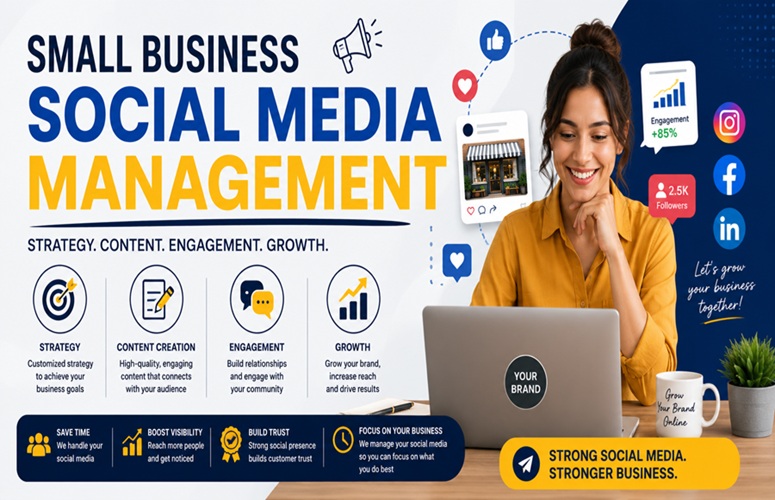
Social media is no longer a supplementary marketing channel for small businesses. It is where customers discover new brands, research purchasing decisions, evaluate credibility before spending money, and expect direct communication when they have a question or complaint. The 2025 Sprout Social Index found that nearly three quarters of consumers expect a response from a business within 24 hours of reaching out on social media, and the same proportion said they would purchase from a competitor if that response did not arrive. For a small business without a dedicated marketing team, those expectations can feel overwhelming. The good news is that social media management in 2026 does not require a team or a large budget. It requires a clear strategy, the right tools, and a realistic approach to where your time is best spent.
Why Social Media Management Matters More Than Posting
The phrase social media management is often interpreted as a scheduling task: choose when to post, create the content, publish it, and move on. This framing misses most of what social media actually does for a small business, and it explains why businesses that post consistently still fail to see commercial results.
Social media works for small businesses when it operates as a complete system with three interdependent components: content creation and publishing, community engagement and response, and performance measurement and iteration. A business that posts without engaging with comments and messages is broadcasting, not communicating. A business that engages without measuring what is working is guessing rather than improving. And a business that measures without changing its approach based on what it learns is collecting data without acting on it.
The commercial outcome of well-managed small business social media is not primarily likes and followers. It is trust and discovery. A consistent, authentic, responsive social presence signals to potential customers that the business is active, professional, and cares about its community. That trust converts into website visits, calls, appointments, and purchases at a rate that passive advertising cannot match.
Choosing the Right Platforms Before Creating Any Content
One of the most consistent mistakes small business owners make in social media management is attempting to maintain an active presence on every major platform simultaneously. The result is thin, infrequent, mediocre content spread across channels where nobody sees it. A stronger approach is to select one or two platforms where your specific target customers actually spend their time and invest in producing genuinely good content there consistently.
For local service businesses, restaurants, retailers, and community-oriented brands, Facebook and Instagram remain the most commercially effective platforms. Facebook continues to be the largest platform for local business discovery, community building, and direct customer communication through Messenger. Instagram’s visual format makes it ideal for businesses with strong photographic content, and its Reels feature consistently delivers the highest organic reach of any content format on the platform in 2026.
TikTok has become genuinely relevant for small businesses with the capacity to produce short-form video content. Its algorithm favors content quality and engagement over follower count, meaning new businesses can reach meaningful audiences without a pre-existing following. The 2026 Social Media Content Strategy Report identified the three E’s, entertainment, education, and emotion, as the content characteristics that consistently perform on TikTok. Small businesses that can authentically produce content in any of those categories have a real opportunity.
LinkedIn is the correct platform for B2B-oriented small businesses, professional service firms, and businesses whose customers make purchase decisions in a professional context. Its reach for thought leadership content and its targeting capability for professional audiences is unmatched by any other social platform.
Pinterest remains highly effective for businesses in food, home decor, fashion, weddings, crafts, and similar visually driven categories where users are actively planning and researching purchases.
Building a Content Strategy That Is Realistic to Sustain
A social media content strategy that requires more time, resources, or creative output than you can realistically produce will collapse within weeks regardless of how good it looks on paper. The most effective strategies for small businesses are built around constraints rather than ideal conditions.
The content mix that consistently performs for small businesses balances four types of posts. Educational content that solves a problem or answers a question your potential customers are asking establishes expertise and builds search value over time. Behind the scenes content that shows the human reality of running the business builds relatability and trust in ways that polished promotional content cannot. Community content that recognizes customers, celebrates local events, or engages with the community the business is part of generates the reciprocal engagement that builds a loyal following. And promotional content that communicates specific offerings, deals, or calls to action converts the goodwill built through the other content types into commercial activity.
A ratio of roughly one promotional post for every three to four value-driven posts is a practical starting point for most small businesses. It ensures that the audience receives enough genuine value to stay engaged without the account feeling like a continuous advertisement.
Content batching is the production technique that makes sustainable content creation possible for solo operators. Rather than creating content daily on an ad-hoc basis, a small business owner who dedicates two to three hours once a week to planning and producing content for the following seven to ten days frees their day-to-day attention for running the business while maintaining consistent publishing without last-minute scrambling.
The Tools That Make Small Business Social Media Management Manageable
The right tools significantly reduce the administrative burden of social media management, consolidating scheduling, publishing, engagement monitoring, and performance reporting into a single interface rather than requiring constant manual platform-hopping.
Buffer remains the most consistently recommended platform for small businesses in 2026 according to independent reviews, specifically because of its simplicity and affordable per-channel pricing. It allows scheduling and publishing across multiple platforms, includes basic analytics, and has an intuitive interface that does not require technical expertise to use productively. Buffer’s paid plans start at around $6 per month per channel, making it accessible for businesses managing three to five platforms.
Hootsuite offers a broader feature set including social listening, competitor monitoring, and its AI-powered OwlyWriter tool that can generate platform-specific captions from a single piece of long-form content. It is more expensive than Buffer at the comparable tier but provides more capability for businesses that need the additional features. Its AI content tools are particularly valuable for small business owners who struggle with blank-page syndrome when creating social copy regularly.
As Sprout Social’s 2026 guide on social media for small business growth emphasizes, community-focused content is the second most desired content type from social users today, with 51 percent of users expecting brands to actively engage with their audiences on all platforms. Tools that consolidate comments, direct messages, and mentions from multiple platforms into a single unified inbox, a feature offered by both Hootsuite and Sprout Social, dramatically reduce the time required to maintain the kind of responsive engagement that customers now expect.
Canva is the design tool that has democratized graphic content creation for small businesses without in-house design resources. Its library of professionally designed templates, branded content kits, and platform-sized formats makes it possible to produce visually consistent social content in minutes rather than hours. In 2026, Canva’s AI-powered Magic Studio features, including background generation, text-to-image creation, and one-click content resizing across platforms, have further reduced the production barrier for small teams.
The Role of AI in Small Business Social Media Management
Artificial intelligence has moved from a novelty to a practical operational tool in social media management, and small businesses that ignore it are beginning to fall behind the pace set by those that integrate it thoughtfully.
AI content generation tools can produce first drafts of captions, post ideas, and content series outlines in seconds, eliminating the time most small business owners previously spent staring at a blank screen trying to develop what to say. The output requires human editing and personalization to reflect the business’s authentic voice, but the difference between starting from nothing and editing a draft is measured in minutes rather than hours.
AI-powered scheduling tools analyze historical engagement patterns and audience behavior to recommend optimal posting times for each platform, ensuring that content is published when the target audience is most likely to see and interact with it. This optimization is something manual management rarely achieves consistently.
AI social listening tools monitor mentions of the business name, relevant industry keywords, and competitor activity across platforms in real time, surfacing conversations that a manual approach would miss. For small businesses that cannot dedicate someone to monitoring social media throughout the day, automated listening provides a safety net that catches customer complaints, PR opportunities, and competitive intelligence passively.
Deciding Whether to Manage Social Media In-House or Hire Help
The decision between managing social media internally and outsourcing to a freelancer or agency is one of the most common points of confusion for small business owners, and it has a different right answer depending on the business’s circumstances.
Managing social media in-house makes sense when the owner or a team member has genuine enthusiasm for the channels, sufficient time to produce consistent quality content, and the discipline to engage with the audience responsively. In-house management produces more authentic, personality-driven content that tends to build stronger community connection than outsourced alternatives. The disadvantage is that in-house management requires time that could be spent on core business activities, and the quality suffers when it becomes deprioritized under pressure.
Hiring a freelance social media manager is appropriate when consistent quality and frequency matter commercially and internal bandwidth is insufficient to deliver them reliably. Freelance social media managers in the United States typically charge $500 to $2,000 per month for small business packages covering two to three platforms, content creation, scheduling, and basic engagement management. The rate varies based on experience, platform count, content volume, and whether original photography or video production is included.
Outsourcing to a social media agency makes sense for businesses with larger budgets, specific campaign needs, or complex multi-platform strategies that require a team rather than a single individual. Agency retainers for small business social media typically start at $2,500 per month and scale based on scope.
Measuring What Actually Matters
The most important discipline in small business social media management is measuring the right metrics rather than the vanity metrics that feel impressive but do not reflect commercial outcomes.
Reach and impressions tell you how many people saw your content. Engagement rate, which measures the proportion of people who saw your content and interacted with it, tells you whether the content resonated. Click-through rate from social posts to your website measures whether social is driving traffic with commercial intent. Conversion tracking, where it is set up, closes the loop by connecting social activity to actual leads and sales.
For most small businesses, a monthly review of three to five key metrics is more useful than daily monitoring of every available data point. The question to ask is not which metrics moved but what changed as a result, and what that change suggests about what to do differently next month.
Social media management for small businesses is not about being everywhere and posting everything. It is about being consistent on the right platforms, producing content that genuinely serves your audience, responding in a way that builds trust, and measuring well enough to improve over time.
